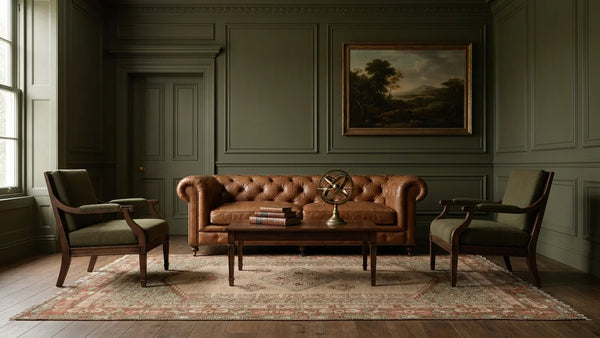
A vintage Persian rug is not a piece of decor. It is a sixty-, eighty-, sometimes hundred-year-old textile woven by hand in a specific Iranian village, dyed with plants and minerals from that region, and shaped by a knotting tradition that predates almost every art form still practiced today. Owning one is closer to owning a small museum piece than buying furniture — and once you understand what you are actually looking at, it is hard to look at machine-made rugs the same way again.
This guide is the long version. If you are buying your first vintage Persian rug, sourcing one for a design project, or trying to figure out whether the piece in your grandmother's hallway is worth restoring, everything below applies. We will cover what makes a rug genuinely Persian, the major weaving regions, how knots and dyes reveal age and value, what a fair 2026 price looks like, and how to avoid the most common buying mistakes.
Shop all vintage Persian rugs at alarug

What counts as a "vintage Persian rug"?
In the rug trade, three words get used loosely — antique, vintage, and semi-old — and they matter for both price and provenance.
- Antique: roughly 80 years old or older. Pre-1945 in most catalogs.
- Vintage: 20 to 80 years old. The majority of pieces sold in 2026 sit in this window.
- Semi-old / decorative: under 20 years. Still hand-knotted, but not yet patinated.
- New production: woven in the last decade, often for export markets.
A vintage Persian rug, then, is a hand-knotted rug woven in Iran between roughly 1945 and 2005. It uses wool, cotton, or silk on a foundation of cotton or wool warps and wefts, with patterns and palettes that trace back to a specific weaving region — Tabriz, Kashan, Heriz, Qom, and dozens of others.
What separates a Persian rug from a Turkish, Caucasian, or Central Asian rug comes down to four signals: the asymmetrical (Senneh) knot, finer knot density, curvilinear floral and medallion patterns, and a distinct color vocabulary anchored in madder red, indigo blue, walnut brown, and saffron yellow.
A short history (and why it still matters)
Persian carpet weaving is documented for at least 2,500 years. The Pazyryk carpet — the oldest knotted-pile rug ever discovered — was woven around the 5th century BCE and is broadly accepted to be Persian in origin. The craft reached its first peak under the Safavid dynasty in the 16th and 17th centuries, when royal workshops in Tabriz, Isfahan, and Kashan produced rugs that now live in museum collections in London, New York, and Doha.
This matters for buyers in 2026 because vintage Persian rugs are direct descendants of those workshops. A 1960s Tabriz uses the same patterns, the same knot, and (in many cases) the same dye plants as its 1620 ancestor. The weaver in 1960 was very often the grandson of the weaver in 1900, who was the great-grandson of someone trained in the late Safavid tradition. That continuity is the reason a hand-knotted Persian rug carries premium value while a stylistically similar machine-made rug does not.
The major Persian weaving regions
A "Persian rug" can mean dozens of distinct regional traditions. The eight below cover roughly 80% of what you will encounter on the vintage market. Knowing them helps you read a rug — and helps you avoid overpaying for something mislabeled.

Tabriz
The most prolific and recognized weaving city in Iran. Tabriz rugs span an enormous quality range, from coarse village pieces to extraordinarily fine "Mahi" (fish) pattern carpets with 500+ knots per square inch. Designs are typically curvilinear with central medallions and dense floral fields. Palettes lean rich: madder red, deep indigo, ivory accents.
Kashan
A central city long associated with master workshops. Kashan rugs are recognized for their density, fine wool, and balanced medallion designs. Antique Kashans are some of the most sought-after pieces in the global market; vintage Kashans from the 1950s–80s are still attainable and exceptional value.
Heriz and Serapi
Heriz (and its older, finer cousin Serapi) come from a mountainous region in northwest Iran. The signature look is bolder and more geometric than other Persian regions — a strong central medallion, angular corner spandrels, often a brick-red field and indigo border. Heriz rugs are favorites of American collectors and adapt remarkably well to modern interiors.
Qom
A holy city that became a major weaving center only in the 20th century. Qom rugs are typically silk or wool with silk highlights, very finely knotted, with intricate floral or hunting-scene patterns. Premium pricing reflects the silk content and labor.
Isfahan and Nain
Two cities that produce some of the finest Persian rugs ever made. Isfahans favor a "Shah Abbasi" floral lattice with central medallion; Nains are recognizable by their distinctive ivory ground, blue and beige accents, and silk-edged designs. Both are luxury-tier pieces.
Sarouk
A village weaving tradition that produced two distinct generations. Old Sarouks (pre-1940) carry curvilinear floral patterns and are highly collectible. American Sarouks (1920s–40s) were re-dyed in the US to a uniform raspberry-rose, then aged into the warm dusty-pink palette familiar from grandmothers' formal living rooms.
Bidjar
Known as "the iron rug of Persia." Bidjars are hammered tight during weaving, producing an unusually stiff and durable foundation that can last 150+ years in regular use. Patterns are geometric, palettes are rich, and pieces are coveted by collectors who actually use their rugs.
Tribal traditions (Qashqai, Bakhtiari, Lori)
The southern and southwestern Iranian tribes produce more rustic, geometric rugs woven by nomadic or semi-nomadic weavers. Patterns are improvised within tradition, abrash (color variation) is pronounced, and individual pieces feel less polished but more alive than city productions. These have appreciated steadily in the 2020s as collectors gravitate toward expressive, less formal vintage.
How to tell a genuine vintage Persian rug
Five things to inspect, in order. None of them require expertise — only attention.
1. Look at the back
Flip the rug. A hand-knotted Persian rug shows the pattern mirrored on the back with visible individual knots in rows. Machine-made rugs show a uniform grid, often with a glued or fabric backing. If you cannot see clear knot rows, it is not hand-knotted.
2. Check the knot
Persian rugs use the asymmetrical (Senneh) knot — the yarn wraps around one warp thread and passes under the next. Turkish rugs use the symmetrical (Ghiordes) knot, where the yarn wraps around two warps. You do not have to dissect a rug to see this; on a worn piece, the knot type is visible at the back.
Knot density varies hugely. Coarse village rugs run 60–120 knots per square inch. Fine city rugs run 250–500+. Qom silks can exceed 800. Higher density is not automatically "better" — it is one signal among many. A 100-KPSI Heriz can be more valuable than a 400-KPSI workshop rug if the design and condition warrant.
3. Inspect the fringe
The fringe of a hand-knotted Persian rug is an extension of the warp threads — the structural strings the rug is woven on. It is not sewn or glued on. If the fringe looks like trim attached to the edge, the rug is machine-made.
4. Look for irregularities
Hand-knotted rugs have personality. Lines wobble slightly. Colors shift across a single field (this is called abrash and is a feature, not a flaw — it reflects different dye lots in the original wool). Patterns may not be perfectly symmetrical. Small repairs — re-piling, re-fringing, edge restorations — are normal on vintage pieces and do not necessarily reduce value if done well.
5. Smell and feel
Wool has a faint, characteristic lanolin scent. Synthetic fibers smell like plastic or chemicals. A vintage Persian rug feels heavy in the hand for its size, with a dense, slightly oily wool pile that springs back when you press it.
Materials, dyes, and what they tell you
A vintage Persian rug's value lives in its materials. Three components matter most.
Wool
The best Persian rugs use highland sheep wool with high lanolin content, hand-spun into yarn before dyeing. This wool takes natural dyes deeply, wears slowly, and develops the soft sheen that collectors prize. Industrial yarn — machine-spun, chemically washed — never quite matches it. The wool quality is often the single biggest driver of long-term value.
Cotton or wool foundation
The warp and weft (the structural threads the knots are tied around) are cotton in most city rugs and wool in most tribal pieces. Cotton produces a flatter, more even back; wool produces a more flexible, sometimes wavier back. Neither is inherently better — they suit different design traditions.
Dyes
Vintage Persian rugs use a mix of natural dyes (madder root for red, indigo for blue, walnut husks for brown, pomegranate skins for yellow) and early synthetic dyes (introduced in the late 19th century). Natural dyes age beautifully into muted, painterly tones. Some early synthetics, like aniline reds, can fade unevenly or bleed when wet.
A quick test: rub a damp white cloth on a dyed area in an inconspicuous corner. Significant color transfer suggests poor dye stability and lowers value. Slight transfer on very old pieces is normal and not disqualifying.
Patterns and what they mean
Persian rug designs are a vocabulary, not random ornament. A few of the patterns you will see again and again:
- Boteh — the teardrop or "paisley" motif. Symbol of life, eternity, and the cypress tree.
- Tree of Life — a vertical tree with branching motifs, common in tribal and Bakhtiari pieces.
- Gül — stylized rosette, anchor of Turkmen and some Persian tribal designs.
- Herati / fish pattern — a rhomboid with a central rosette flanked by curved "fish" leaves. The signature Tabriz pattern.
- Shah Abbasi — large palmettes and floral lattices named for the Safavid king who codified the design.
- Medallion — central oval or diamond, typical of city workshop pieces.
- Garden / chahār bāgh — a grid representing the four quarters of a Persian garden, often with stylized streams and cypresses.

Reading the pattern tells you the region, the rough era, and often the original purpose of the rug. A Tree of Life rug was often a marriage piece; a hunting scene was a presentation rug for a wealthy patron; a garden design was a meditation aid.
Sizes and where they fit
Persian rugs were originally woven for specific spaces in Iranian homes — and those formats translate directly into Western interior dimensions.
| Persian name | Size range | Typical use today |
|---|---|---|
| Pushti / Yastik | 2x3 ft | Doormat, accent, layering piece |
| Zaronim | 3x5 ft | Small bedroom, entryway, kitchen |
| Dozar | 4x6 to 5x7 ft | Office, reading nook, small dining |
| Kelleh (runner) | 3x10 to 4x16 ft | Hallway, behind a sofa, gallery |
| Kenareh (long runner) | 2.5x10 to 3x20 ft | Long hallway, stair runner |
| Mian Farsh (main) | 7x10 to 9x12 ft | Living room, dining room |
| Ghali (large) | 10x14 ft and up | Great room, formal dining |
When choosing a size, the universal rule is to leave at least 8 inches of floor visible on all sides in a dining or living area, and to make sure all front legs of furniture sit on the rug. In a hallway, leave 4–6 inches of floor visible on each side of a runner.
What a vintage Persian rug costs in 2026
Prices have climbed steadily since 2020, driven by limited supply (Iran's weaving output has dropped significantly), strong design-trade demand, and the disappearance of legacy estate inventory. Rough ranges for genuine vintage hand-knotted Persian rugs in 2026:
- 2x3 ft pushti, village grade: $150–$400
- 3x5 ft zaronim, decorative: $350–$900
- 5x7 ft dozar, mid-range: $700–$2,500
- 8x10 ft Mian Farsh, mid-range: $1,800–$6,500
- 8x10 ft Tabriz / Kashan, fine workshop: $5,000–$15,000+
- 9x12 ft Heriz, antique grade: $4,000–$12,000+
- 3x10 ft kelleh runner: $900–$3,500
- Qom silk, any size: $3,000 per square meter and up
- Tribal Qashqai / Bakhtiari, 5x7: $800–$3,000

Suspiciously cheap pricing (a $200 "vintage Persian 8x10" on a marketplace) almost always indicates a machine-made reproduction, a heavily damaged piece, or a misrepresented modern import. Suspiciously expensive pricing without provenance — meaning verified region, age, and condition documentation — usually means a markup, not a museum piece.
Three factors that move price within these ranges:
- Wool quality — old highland wool with natural sheen commands a premium.
- Condition — even wear is fine; structural damage, missing pile, or unstable foundation drops value sharply.
- Color and design — pieces that read "soft, faded, neutral" sell faster in 2026 than saturated or busy designs, even at equal weave quality.
Caring for a vintage Persian rug
Wool is one of the most resilient fibers ever discovered, and vintage Persian rugs have already proven they last. Care is mostly about avoiding three things: prolonged dampness, direct sunlight on a single area, and harsh cleaning chemicals.
The short version:
- Vacuum weekly with the beater bar off (or a hand-held vacuum). Never vacuum the fringe — it tears.
- Rotate the rug 180 degrees every six months to even out foot traffic and sun fading.
- Blot spills immediately with cold water and a clean white cloth. Never rub. Never use bleach or oxygen cleaners on wool.
- Pad the rug with a felt-and-rubber pad sized 1 inch shorter than the rug on each side. This prevents slippage and extends life by years.
- Professional wash every 3–7 years, depending on traffic. Always use a hand-wash specialist, never a steam-cleaning service.
- Storage: roll, never fold, and wrap in breathable cotton or muslin. Add cedar blocks against moths. Avoid plastic at all costs.
How to buy a vintage Persian rug online (without getting burned)
Most vintage rug sales in 2026 happen online. The category is full of misrepresentation — "vintage Persian" is one of the most abused descriptors on marketplaces. Five rules cut through it.
- Look at the back in the listing photos. If a seller will not show the back, walk away. Hand-knotted is verifiable in five seconds with a clear back photo.
- Demand region, age, and origin. A seller who cannot tell you the weaving region, approximate decade, and country of origin is selling something they did not source themselves.
- Read the return policy carefully. "All sales final" on a four-figure rug is a red flag. Reputable dealers offer 7–14 day inspection windows.
- Verify with a photo of the rug in a real space. Many marketplace listings use only flat-lay photos against neutral backgrounds. A photo in a room confirms the colors match across lighting.
- Ask one open-ended question. "What drew you to this piece?" An honest seller will give you a specific answer — the abrash, the era, the wool. A reseller will reply with marketing copy.
At alarug, every piece is photographed front and back, region and approximate age are documented, return windows are 14 days, and the team can answer specific questions about provenance for any piece in the inventory.
Where vintage Persian rugs are heading in 2026 and beyond
Three forces are shaping the market right now.
Supply is shrinking. Iran's rug-export numbers have declined every year since 2018, and the generation of weavers trained in pre-revolution master workshops is aging out. New production exists but in nothing like the same volume or quality as the 1950s–80s peak.
Demand is shifting from formal to faded. Saturated, formal Persian rugs (deep ruby fields, ornate borders) are no longer the default purchase. Soft, faded, neutral pieces — and the regional traditions that produce them — are commanding faster sales and higher per-square-foot prices.
Vintage is being recognized as investment. Auction houses are reporting consistent appreciation on certified pieces in the 6–12% annual range. The combination of declining supply and rising design demand is unlikely to reverse in this decade.
If you are buying in 2026, you are buying into a finite supply at the low end of a long-term price curve. Quality pieces have rarely been more interesting to own.
FAQ
What is the difference between vintage, antique, and semi-antique Persian rugs?
Antique rugs are 80+ years old (pre-1945). Vintage rugs are 20–80 years old. Semi-antique typically refers to pieces 40–80 years old. Beyond age, condition, weave quality, and region drive value more than the label itself.
How can I tell if a Persian rug is hand-knotted or machine-made?
Look at the back. A hand-knotted rug shows individual knots in clear rows, with the pattern mirrored. The fringe is an extension of the warp threads, not sewn on. Machine-made rugs show a uniform grid back and often have a fabric or glued backing.
Are vintage Persian rugs worth the money?
For genuine hand-knotted pieces in good condition from a recognized weaving region, yes — and increasingly so. The supply is limited, the craft is shrinking, and well-preserved pieces have appreciated steadily over the last decade. Machine-made imitations are not investments and will not appreciate.
How long do vintage Persian rugs last?
Indefinitely, with reasonable care. Many rugs sold today are 60–80 years old and structurally sound for another century. Wool wears down slowly, and the fading and patina that develop over time enhance rather than diminish value for most collectors.
What is the best size vintage Persian rug for a living room?
For a standard US living room (12–14 ft wide), an 8x10 or 9x12 sits comfortably. The rule is that all front legs of major furniture (sofa, armchairs) should sit on the rug, with at least 8 inches of floor visible on all sides.
Why do vintage Persian rugs have color variations?
The variation is called abrash and reflects different dye lots in the original wool. Weavers used what they had — a new batch of madder root, a slightly different indigo vat — and the resulting color shifts give the rug depth and movement. Modern industrial rugs lack abrash, which is why they read as flat.
Are silk Persian rugs better than wool?
Different, not better. Silk rugs (Qom is the most famous) are finer, lighter, and have higher luster, but they are also more delicate and less suited to high-traffic areas. Wool is the right choice for floors that get daily use. Silk shines on walls, in bedrooms, and as collector pieces.
Can I put a vintage Persian rug in a kitchen or dining room?
Yes — they were originally woven for everyday Iranian homes, including spaces with cooking and dining. Wool repels liquid better than most synthetic fibers. A good rug pad protects the rug, and prompt blotting handles spills. The patina that builds over years of use is part of what makes a vintage rug interesting.
Start shopping
alarug carries one of the deepest vintage Persian rug inventories online — every piece hand-selected, photographed front and back, with region and approximate age documented. New arrivals weekly, free US shipping, and a 14-day return window on every order.